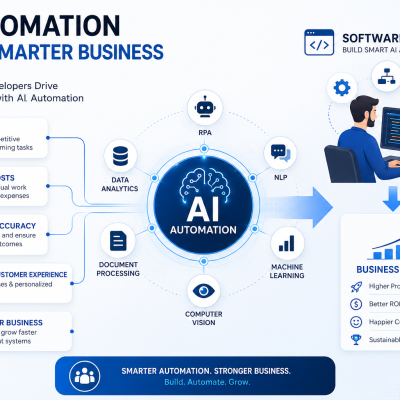
The Future of Workflow Automation Systems: How Mobile Application Development Companies Are Transforming Business Operations
Businesses today are under constant pressure to improve productivity, reduce operational costs, and deliver faster customer experiences. Traditional workflow systems built on manual approvals, spreadsheets, emails, and disconnected software are no longer sufficient for modern enterprises.
The future belongs to intelligent workflow automation powered by custom mobile applications, AI-driven decision making, cloud connectivity, and real-time data processing. Organizations are moving beyond simple automation into a new era where mobile applications become intelligent business assistants capable of automating entire operational processes.
A professional mobile application development company plays a critical role in designing these intelligent systems by developing secure, scalable, and AI-ready mobile applications that automate business workflows from end to end.
What is Workflow Automation?
Workflow automation is the process of replacing repetitive manual tasks with intelligent digital processes that automatically collect information, make decisions, notify stakeholders, update databases, and complete business operations with minimal human intervention.
Instead of employees spending hours on repetitive administrative work, automated mobile applications execute these tasks in seconds while maintaining higher accuracy and consistency.
Modern workflow automation includes:
- Task Automation
- Document Processing
- Approval Management
- Customer Communication
- Inventory Updates
- Employee Collaboration
- Real-Time Reporting
- AI-Based Decision Support
The Future of Workflow Automation
The next generation of workflow automation is evolving from basic rule-based systems into AI-powered intelligent business ecosystems. Mobile applications are becoming the central control hub where employees, customers, field teams, and management collaborate through automated workflows.
1. AI-Powered Intelligent Decision Making
Future mobile applications won’t simply follow predefined rules. They will understand business context, analyze incoming information, identify exceptions, and recommend or execute the next best action.
Rather than relying on static “if-this-then-that” workflows, AI-enabled applications continuously optimize business processes based on real-time data and operational patterns.
2. Hyper Automation Across Business Systems
Organizations increasingly use multiple software platforms including CRM, ERP, HRMS, accounting software, inventory management, payment gateways, communication tools, and cloud storage.
Modern mobile applications connect these systems into one automated workflow where information flows seamlessly without manual intervention.
For example:
- Customer inquiry automatically creates a CRM record.
- Sales approval generates an invoice.
- Payment confirmation updates accounting.
- Inventory adjusts automatically.
- Delivery teams receive instant notifications.
- Management dashboards update in real time.
3. Mobile-First Business Operations
Employees no longer work exclusively from office desktops.
Sales executives, managers, delivery teams, healthcare workers, technicians, warehouse operators, and field engineers require access from anywhere.
Custom mobile applications enable users to:
- Approve requests instantly
- Upload documents
- Track operations
- Receive AI recommendations
- Manage customers
- Monitor business performance
- Complete workflows remotely
Business decisions happen faster because approvals and updates are available directly from mobile devices.
4. Human-in-the-Loop Automation
Not every business decision should be fully automated.
Modern workflow systems combine AI with human oversight by allowing managers to review and approve high-value transactions, contracts, payments, or sensitive business operations directly from mobile devices before workflows continue automatically.
This creates the perfect balance between automation and business control.
5. Native Mobile Capabilities Driving Automation
Mobile applications now integrate directly with smartphone features to simplify data collection and trigger automated workflows.
These capabilities include:
- Camera-based document capture
- Optical Character Recognition (OCR)
- Barcode and QR code scanning
- Voice-to-text input
- GPS and geolocation tracking
- Biometric authentication
- Push notifications
- Digital signatures
How a Mobile Application Development Company Helps Automate Your Workflow
Business Process Analysis
The automation journey begins by understanding your existing workflow, identifying bottlenecks, repetitive tasks, approval delays, and communication gaps.
The objective is to redesign processes for maximum efficiency before development begins.
Custom Workflow Design
Every organization has unique operational requirements.
Instead of using generic software, custom mobile applications are developed specifically around your business processes, employee roles, customer interactions, and operational goals.
Integration with Existing Systems
Modern applications integrate seamlessly with existing business software, including:
- CRM Platforms
- ERP Systems
- HR Management Software
- Inventory Systems
- Accounting Software
- Payment Gateways
- Cloud Storage
- Email Platforms
- Third-Party APIs
AI-Driven Automation
Development companies integrate artificial intelligence into mobile applications to automate intelligent tasks such as:
- Document classification
- Data extraction
- Customer query routing
- Smart notifications
- Predictive recommendations
- Automated reporting
- Task prioritization
Secure Cloud Infrastructure
Modern workflow applications are built using scalable cloud architecture that enables:
- Real-time synchronization
- Secure data storage
- Automatic backups
- Multi-device access
- Role-based permissions
- High availability
- Enterprise-grade security
Analytics and Business Intelligence
Automation platforms provide management with live dashboards displaying:
- Employee productivity
- Workflow completion time
- Pending approvals
- Customer response metrics
- Operational bottlenecks
- Financial performance
- Resource utilization
Industry Applications of Mobile Workflow Automation
Healthcare
Healthcare organizations use mobile applications to streamline patient registration, appointment scheduling, digital medical records, compliance documentation, and follow-up communication. Medical staff can securely access patient information and update records in real time, improving efficiency and patient care.
Finance
Financial institutions automate expense approvals, fraud monitoring, invoice processing, document verification, compliance checks, and audit reporting through secure mobile applications, reducing manual effort while improving accuracy and regulatory compliance.
Field Services & Logistics
Field technicians use mobile applications to receive job assignments, capture service reports, update inventory, collect customer signatures, and optimize delivery routes based on real-time location data. This improves response times and operational efficiency.
Sales & CRM
Sales teams can instantly capture customer information using smartphone cameras, automatically update CRM records, schedule follow-up activities, generate quotations, and receive reminders—all from a single mobile application without manual data entry.
Manufacturing
Manufacturers automate production monitoring, equipment maintenance schedules, quality inspections, inventory tracking, and workforce management through connected mobile applications, helping reduce downtime and improve operational control.
Benefits of Workflow Automation Through Mobile Applications
- Reduced manual workload
- Faster business approvals
- Improved operational efficiency
- Lower operational costs
- Enhanced customer experiences
- Better data accuracy
- Increased employee productivity
- Real-time visibility into business operations
- Stronger security and compliance
- Scalable processes that support business growth
Why Custom Mobile Applications Are the Future of Business Automation
Off-the-shelf software often forces businesses to adapt their processes to predefined workflows. Custom mobile applications are different—they are built around the way your business actually operates.
As technologies such as artificial intelligence, machine learning, cloud computing, and intelligent automation continue to evolve, businesses need flexible, scalable platforms that can adapt to changing requirements. A custom mobile application provides this foundation, enabling organizations to automate complex workflows, integrate with existing systems, and deliver faster, smarter, and more connected operations.
Conclusion
Workflow automation is no longer just about replacing manual tasks—it is about creating intelligent, connected business ecosystems that operate efficiently across departments, devices, and locations. Mobile applications have become the central interface for employees, customers, and management to collaborate, make decisions, and complete business processes in real time.
By partnering with an experienced mobile application development company, businesses can design tailored automation solutions that integrate AI, cloud services, enterprise software, and mobile technologies into a unified workflow. The result is greater efficiency, improved accuracy, enhanced customer experiences, and a scalable digital foundation that prepares organizations for the future of work.