
Healthcare Application Development: Smarter Digital Healthcare Solutions
The healthcare sector is rapidly embracing digital technologies to improve the patient experience, streamline medical operations, and expand access to care. From appointment scheduling and telemedicine to electronic health records, remote monitoring, and AI-powered support, mobile healthcare apps are now becoming central to modern healthcare delivery.
A thoughtfully designed healthcare app enables users to connect with medical professionals, access vital information, manage appointments, and receive services more conveniently. For healthcare providers, digital platforms can facilitate better communication, reduce administrative workloads, and make healthcare processes more efficient.
AppDevelopers.mobile partners with businesses and healthcare organizations to build custom mobile apps using Android, iOS, Flutter, React Native, backend systems, APIs, cloud solutions, automation, and AI integration. Our focus is on developing secure, scalable mobile applications with the support of dedicated and experienced development teams.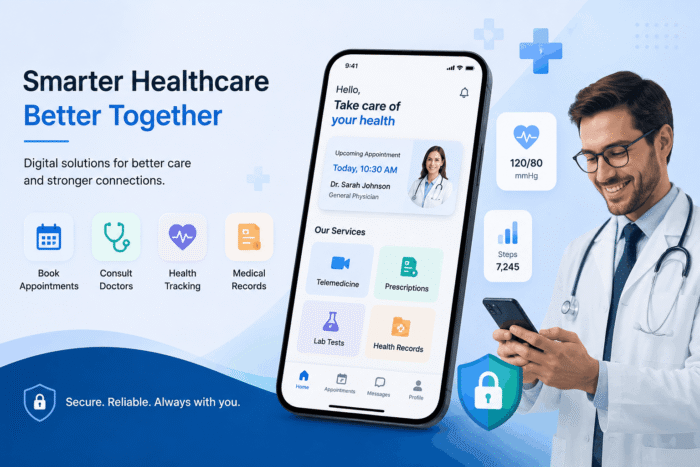
Why Healthcare Apps Matter
- Complex interactions: Patients, doctors, clinics, laboratories, pharmacies, and administrators all need to stay connected.
- Manual management can be slow: Healthcare apps can centralize appointments, information, and communication.
- Booking and managing appointments
- Remote consultations
- Accessing and uploading medical information
- Notifications and reminders
- Secure messaging with care teams
- Treatment tracking
Patient-Centered Mobile Design
- User-friendly experience: Simple registration, clear navigation, and accessible features can improve usability for patients.
- Key elements:
- Secure logins
- Easy doctor search
- Appointment scheduling
- Digital reminders
- Document uploads
- Prescription information
- Secure notifications
Telemedicine & Virtual Care
- Remote access: Healthcare apps can support video and audio consultations, secure chat, appointment scheduling, and follow-ups.
- Benefits: Virtual care can reduce unnecessary travel and may be particularly useful for routine consultations or follow-up care.
- Customizable: Features can be tailored to specific operational and clinical requirements.
Streamlining Appointments
- Automated scheduling: Patients can select an available time slot, receive confirmation, and get reminders.
- Management: Apps can help manage doctor availability, rescheduling, cancellations, and administrative dashboards.
- Result: Less administrative work and a better patient experience.
Healthcare Apps for Providers
- Not just for patients: Medical teams may also need mobile access to:
- Patient information and records
- Daily schedules
- Internal communications
- Task assignments and notifications
- Reporting tools
- On the go: Mobile healthcare applications can be particularly useful for field staff and distributed teams.
Secure Backend & API Integration
- Beyond the interface: Robust backend systems can manage users, appointments, data, and notifications.
- Key features:
- Database design
- User authentication and role management
- API development
- Cloud integration
- Administrative dashboards
- Third-party integrations
- Scalability: A well-designed backend can make it easier to add new features and integrations as the application grows.
AI & Automation in Healthcare Apps
- Improving efficiency: AI can help:
- Organize requests
- Summarize non-clinical information
- Automate notifications
- Route tasks
- Identify workflow patterns
- Goal: Reduce manual administrative work and allow healthcare staff to focus more on patient care.
Remote Monitoring & Connected Healthcare
- Integrated experiences: Healthcare apps can connect with:
- Wearable devices
- Backend systems
- Administrative dashboards
- Notification services
- Workflow: Device or patient input → Secure backend → Healthcare review → Action or notification
Designing for Scale
- Start small and grow: An application can begin with essential features, such as appointment scheduling, and later expand to include:
- More users and locations
- New features and integrations
- Automation and dashboards
- Technology stack: Flexible backend systems, scalable databases, secure APIs, cloud infrastructure, and modular applications can support future growth. Flutter and React Native may support cross-platform development, while native development can be suitable for specialized requirements.
UI/UX in Healthcare
- Clarity is crucial: Simple forms, easy navigation, clear notifications, and accessible design can improve the user experience.
- Streamlined journeys: For example: Book a provider → Choose a time → Enter information → Confirm the appointment.
Supporting Existing Healthcare Apps
- Not always built from scratch: Existing applications can be improved or modernized through:
- Bug fixes and performance improvements
- UI/UX upgrades
- New feature development
- API integrations
- Ongoing maintenance and cross-platform support
- Flexible engagement: Developers and teams can be engaged on a part-time, full-time, contract, or dedicated basis, depending on project requirements.
Picking the Right Approach
- Ask first: Who will use the application? What core problem will it solve? What integrations are required? Which features are essential for launch, and which can be added as the application grows?
Why AppDevelopers.mobile?
- Expertise across: Android, iOS, Flutter, React Native, backend development, APIs, cloud technologies, AI, UI/UX, dashboards, and application modernization.
- Custom solutions: Patient applications, telemedicine platforms, provider tools, administrative dashboards, connected healthcare solutions, and more.
- Flexible engagement: Team size and technical expertise can be tailored to your project requirements.
Move Healthcare Forward
- Powerful healthcare applications: Can help make healthcare services more accessible, reduce administrative workloads, and improve connections between teams and patients.
- Focus on real needs: Simpler access, better information flow, less manual work, and scalable technology.