
The Future of Workflow Automation Systems
Modern organizations are constantly searching for ways to manage growing workloads without adding unnecessary costs or administrative overhead. Employees juggle client requests, approvals, documents, data, follow-ups, and communications across multiple platforms—tasks that can become slower and harder to manage as companies scale.
Workflow automation systems are becoming essential to efficient business operations.
The future of process automation isn’t just about digitizing manual work—it’s about building smarter, more connected systems that move information seamlessly, empower people, improve visibility, and help organizations adapt faster.
At AppDevelopers.mobile, we partner with businesses to create digital solutions using mobile apps, backend systems, APIs, automation, AI, and custom applications to support more efficient operations.
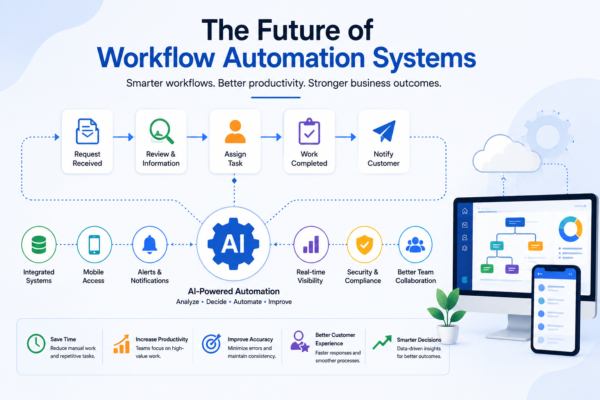
What Is a Workflow Automation System?
A workflow is a series of steps used to complete a business process. For example:
Customer Request → Review Information → Assign Task → Complete Work → Notify Customer
Without automation, employees may need to manually move information, assign tasks, send email updates, and track progress. A workflow automation system can handle many of these steps automatically based on predefined rules and events.
Modern automation systems can:
- Transfer data between connected applications
- Automatically assign tasks
- Send alerts and reminders
- Manage approvals
- Update records
- Track progress and pending work
The result is less repetitive manual work and a more organized, efficient process.
From Basic Automation to Smarter Workflows
Traditional automation follows simple, rule-based instructions:
Form Submitted → Create CRM Record → Assign to Team → Send Confirmation
The latest workflow automation solutions are becoming smarter and more adaptable. By integrating AI, these systems can:
- Identify request types
- Sort and prioritize information
- Extract key details from documents
- Suggest next actions
- Route work to the appropriate team
This shift enables smart workflow management, where AI can help process information and move work forward, freeing employees from tedious review and sorting tasks.
The Future: Seamless, Connected Systems
Most companies rely on a wide range of software platforms, including:
- CRMs
- Mobile apps
- Payment platforms
- Accounting systems
- Project management tools
- Customer service platforms
- Databases
- Internal dashboards
The challenge is getting these systems to work together effectively.
API integrations and connected backend systems are becoming the backbone of modern workflow automation. Connected systems can automatically share relevant information, helping eliminate manual data entry and communication gaps.
For example:
Customer Order → Payment Confirmation → Inventory Update → Delivery Assignment → Customer Notification
A connected workflow helps ensure that each step moves smoothly, with minimal human intervention.
AI: The Next Level of Automation
AI is likely to play an increasingly important role in process automation. While traditional automation works well for structured tasks, much of the information businesses handle is unstructured—such as emails, requests, documents, and conversations.
AI can help systems:
- Sort and categorize requests
- Summarize lengthy content
- Extract key information
- Recognize patterns and trends
- Suggest replies or actions
- Support smarter decision-making
AI isn’t about automating every decision. It can handle routine information processing while flagging complex situations for human review. The most effective workflows of the future will combine automation for routine tasks with human judgment for exceptions.
Mobile Workflow Automation on the Rise
Work happens everywhere—not just at desks. Field staff, sales teams, managers, and remote employees need access to information and workflows while on the move.
Mobile apps are becoming increasingly important for workflow automation. They can enable:
- Instant task assignments
- Real-time status updates
- Access to customer and location data
- Photo and document uploads
- Electronic signatures
- Automatic alerts and notifications
Actions completed within a mobile app can instantly update backend systems, notify the next person in the workflow, and keep relevant data up to date—reducing unnecessary calls, emails, and manual reporting.
Enhanced Visibility and Process Insights
One of the greatest benefits of workflow automation is improved visibility. As work moves through digital systems, organizations can track:
- Outstanding requests
- Bottlenecks and delays
- Time spent on each step
- Processes that require the most manual effort
- Common sources of inefficiency
Future automation systems will increasingly use this information to support continuous improvement, helping businesses not only automate processes but also optimize how they operate.
Automation Must Scale with Your Business
What works for 10 employees may not work for 100. As organizations grow, their automation systems need to support:
- More users and departments
- Complex approval chains
- Larger data volumes
- New integrations and workflows
Flexible architecture is essential. Scalable backend systems, APIs, cloud infrastructure, and modular workflows can allow automation to expand alongside business needs—without requiring organizations to start from scratch as they grow.
Security and Human Oversight
As more processes and data become connected, strong security remains essential. Future-ready workflow automation should consider:
- User authentication and role-based access
- Data protection and secure APIs
- Audit trails and activity monitoring
- Manual approvals for sensitive actions
Automation should also maintain appropriate human oversight. Not everything should be automated—critical decisions, sensitive information, and unusual cases may require human review and approval.
Future-ready automation means building better systems, not necessarily fully autonomous ones.
How AppDevelopers.mobile Supports Workflow Automation
At AppDevelopers.mobile, we help organizations transform manual processes into integrated digital workflows. Our services include:
- Custom mobile app development for Android and iOS
- Flutter and React Native development
- API integrations and backend systems
- Web dashboards and business portals
- AI and automation features
- UI/UX design focused on usability
- Application upgrades and ongoing maintenance
- Flexible developer engagement models
Whether you need to automate a specific process, connect existing systems, design a custom workflow platform, or build a mobile solution for your workforce, we can develop solutions around your business goals.
The Future Is Connected, Intelligent, and Efficient
The next generation of workflow automation will be driven by powerful integrations, mobile technology, AI, real-time visibility, and scalable digital infrastructure.
The most successful organizations won’t simply automate everything. They’ll identify where automation can deliver the greatest value, improve clarity, accelerate processes, and allow people to focus on work that matters most.
The future of workflow automation is about equipping people with better systems—not removing them from the process.
AppDevelopers.mobile helps businesses build connected, scalable, and intelligent digital operations designed to support today’s needs and tomorrow’s opportunities.